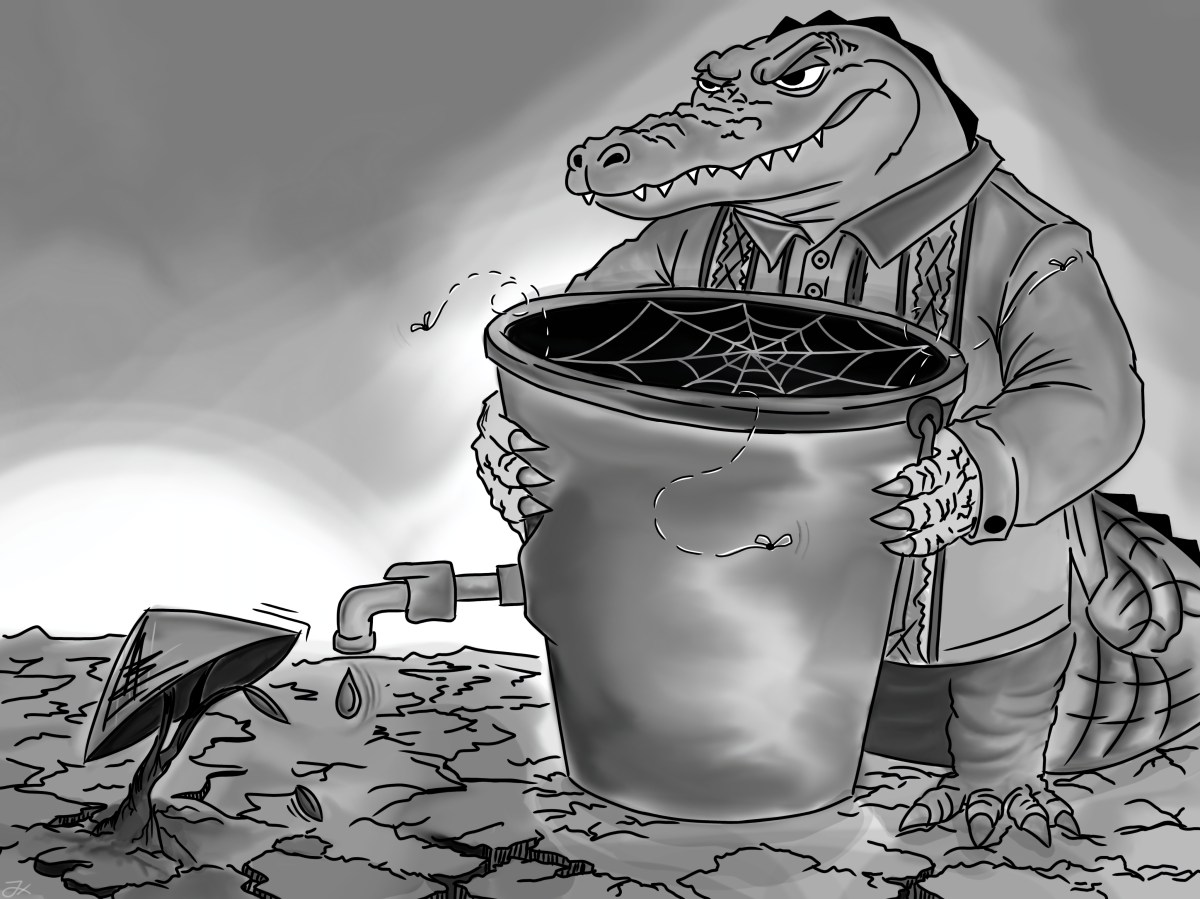
By Sophie Fabrigar and Yohann Udtohan || Illustration by Joxyne Gravoso
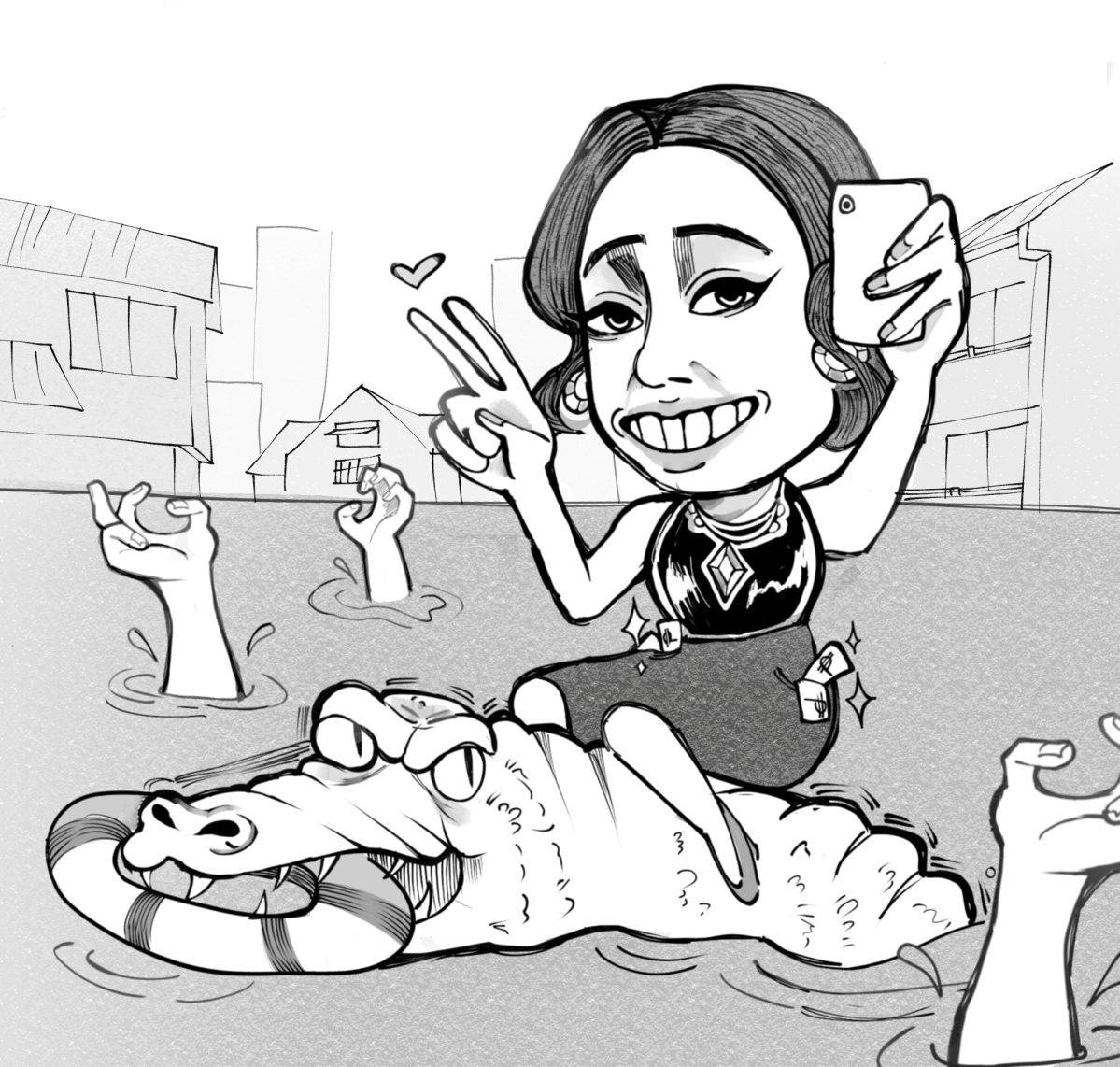
It is a melancholic tragedy to live in a country where rain is both a threat and a blessing, yet neither its arrival nor its absence seems to find the people prepared. When the drought sets in, they wait at taps that give them nothing; when the rains arrive, the water comes in such excess that it swallows the streets they call home. We had nearly surrendered hope of a remedy until President Ferdinand Marcos Jr., in his wisdom, offered one: prepare buckets to collect rainwater as the country braces for a possible Super El Niño. At last, a national solution that fits in every household. It is inexpensive, portable, and requires no billion-peso budget. It fits, quite literally, in a balde.
When some ungrateful citizens questioned this ingenious proposal, Malacañang’s press office had an answer of equally remarkable simplicity: they ought to buy themselves “buckets and buckets of brains.” We confess we found this reassuring. At last, someone in the government had identified a shortage more fundamental than water, and one which, unlike water, could apparently be remedied by a trip to the store. Indeed, the market seems to have understood the President’s vision before the rest of us did, with reports of increased demand for buckets and drums in Marikina following his advice. If only every government initiative enjoyed such immediate public participation.
We therefore propose that the balde be adopted as the official instrument of national development. If households must provide their own containers to catch whatever water the heavens permit, they may as well provide their own solutions to whatever problems the government cannot prevent. Consider flood control, on which so many billions have been spent, yet which has not spared many communities from knee-deep water. The sensible response is to equip every family with a bucket and instruct them to bail their homes and streets dry, one scoop at a time.
When the power grid stages its customary blackout, which it does with a punctuality our public transportation might envy, Filipinos need only procure a balde and stock it with fireflies, whose modest illumination may prove more dependable than the nation’s electrical infrastructure. Commuters stuck in the long line of morning traffic may carry one balde to sit on, and though fares will not fall, they will enjoy the dignity of having brought their own seats. As for Filipinos who have grown weary of expecting competence from their elected officials, a balde of patience is sold in the same aisle as the brains.
Indeed, the possibilities are endless. If public hospitals run short of beds, patients may stack four baldes to fashion a makeshift cot, drape a curtain over the arrangement for privacy, and rest comfortably in the knowledge that even hospitalization is an exercise in resourcefulness. If classrooms grow crowded, children can turn their baldes upside down and use them as chairs, learning from an early age that education is not something a government provides but something a child must improvise. Should the country experience another power shortage, every household may be instructed to catch lightning in a balde. The Department of Energy need only distribute lids to prevent the electricity from escaping. And as temperatures climb to unbearable heights, citizens may be instructed to wear their baldes as hats. Thus, the balde shall serve not only a practical purpose but also as a bold fashion statement, ushering in a new era of climate-conscious couture in which the size of one’s headwear reflects the severity of one’s suffering.
Some may object that buckets cannot build reservoirs, repair water systems, prevent floods, or guarantee a reliable supply of clean water. These critics, we fear, misunderstand the elegance of the proposal. Such infrastructure requires planning, public funds, competent administration, and accountability—burdensome matters that can be avoided when responsibility is transferred to individual households. Why should the government undertake the expensive business of preventing a crisis when the people can be instructed to prepare for its consequences? Why repair a system when citizens can purchase containers to compensate for its failures? And why demand answers from public officials when the press office has already prescribed the proper remedy for our shortage of brains?
Perhaps, in time, the balde will become the defining symbol of the Filipino people. Every household shall own one, every child shall learn to carry one, and every citizen shall be reminded that survival is a personal responsibility, even when the causes of suffering are public. We shall no longer need grand promises or expensive projects when a simple container can be presented as proof that something has been done.
And should the day come when Filipinos finally ask why they must keep catching the water while those entrusted with governing the country keep passing off buckets as solutions, we are confident that another answer will be ready. Perhaps we shall be told to bring larger buckets. Perhaps we shall be advised to buy more brains. Until then, let every household prepare its balde—for the drought, for the floods, for the next broken promise, and for every failure that might otherwise have demanded an explanation.
After all, the greatest achievement of a government is surely not to keep its people from drowning, thirsting, or going hungry, but to teach them how to endure each condition with a balde in hand. And if the nation should ever run out of water, at least we shall have something left to show for it: a country full of baldes, and a government that can finally claim to have filled them with something.