
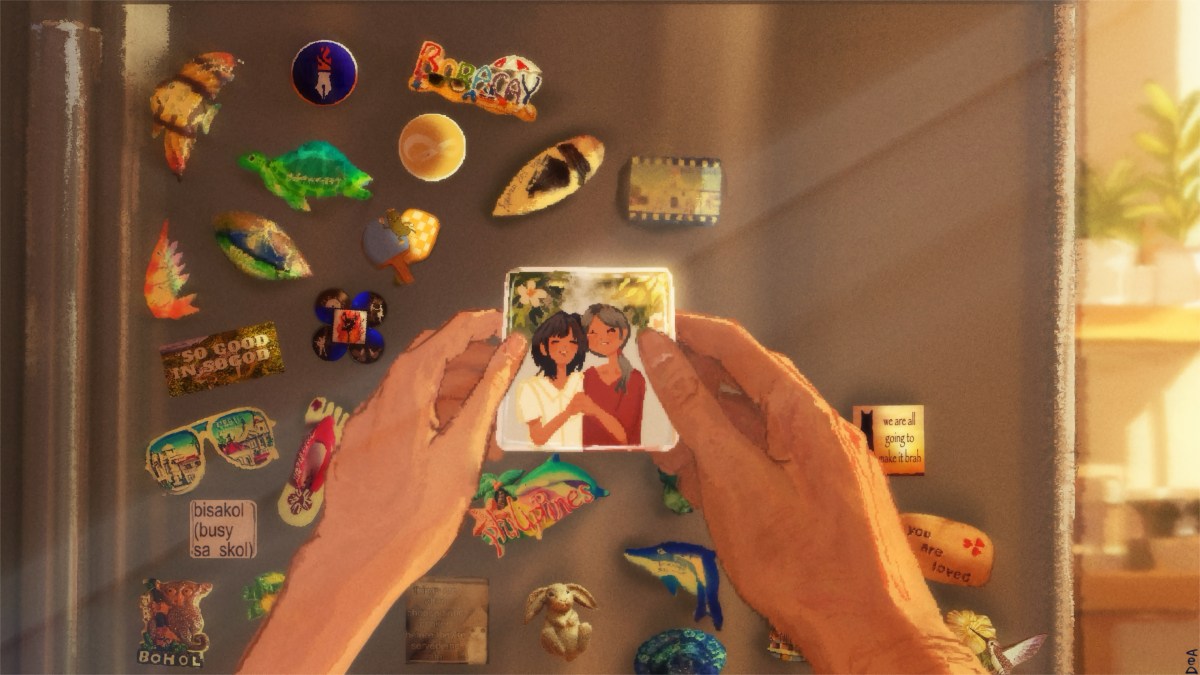
By Emver Gan || Illustration by Deanna Cartalla
“Paldo!”
A voice rang through the classroom. Scholars rushed in, phones in hand, after a message appeared in the class group chat: “GUYS MAY STIPEND NA!” When my last name was called, I stood before the teacher’s table as thirty-six crisp, blue bills were laid out in front of me. The teasing began almost immediately:
“Sana all!”
“Pa-libre daw…”
“Akon nala!”
I could barely hold back a smile as my classmates guessed how I would spend the money—on an up-to-date cellphone, branded clothes, or that Hirono figurine I’d been eyeing since February. Yet none of their guesses could rival the sole thought that managed to occupy the entirety of my mind and eliminate every other desire in my heart—Nanay.
Nanay was the first to question my decision to apply to Pisay, yet once I told her I was sure of it, she was also the first to support me. Perhaps she understood something I had yet to learn: that getting into Pisay was one hurdle, and affording to stay there was another. She gathered the required documents, processed the paperwork, and waited through the delays that stood between us and the financial assistance we needed. Without her, there would have been no four thousand pesos a month—increased to eight thousand pesos in 2026. However, delayed processing brought the accumulated amount to thirty-six thousand pesos just this September.
Thirty-six thousand pesos.
The thought of thirty-six thousand pesos would leave most people ecstatic—blissful for the thrill of possibility. For some, it was money finally within reach. For me, it was an opportunity to ease the tension held in the backs that continued to support dreams bigger than myself, to return even just a fraction of the efforts that had been poured into me. For once, the weight of pursuing a dream would not have to rest entirely on the shoulders of those who first taught me to have one.
It was compensation for my mother, who rose before dawn and forced herself out of bed after only five hours of sleep to cook breakfast and get us ready for school. It was a quiet sacrifice, carried out through an almost automated routine yet softened by a weary smile. It was to ease the burden on my father, who carried the weight of opportunities he never had, determined that we would inherit possibilities rather than the same limitations.
That amount was a reparation for the eighteen years my parents had to live through the suffocating reality of raising ambitious children in circumstances that belittled them. But it did not mean the world had finally apologized for the burns and bruises that had imprinted permanent marks on the egos of those who have tenderly patched the holes in my own self-esteem. It is not a boost that puts us ahead, but possibly an attempt to level out the playing field.
Because for us this money is not dagdag; it’s kaltas.
It’s not another add to cart. It’s not another gala to schedule on our calendars. It’s one less problem to worry about. One less meal to skip. One less expense to audit. Perhaps that is why I can’t help but feel frustrated when our stipend is viewed as a material representation of favoritism. That amount of money didn’t make us feel special; it made us grateful. It opened doors that might otherwise have remained shut—not because we lacked the capability, but because we simply didn’t have the means to sustain a life that would enhance our potential. It may be limitless in theory, but in truth, it is often constrained by the amount of money a family can spare.
The world has never been particularly accommodating to those who were born less fortunate. It continues to move, indifferent to the struggles that keep us stuck. For a child growing up in a household where every peso has already been spoken for, the future is rarely imagined without first considering its cost. We begin measuring our dreams against the limits dictated by our circumstances, treating opportunities as calculations and ambition as a luxury we must justify. We mistake what is beyond our means for what is beyond our reach. When a door closes, we seldom question whether it was ever meant to stay closed, and before long, we forget it was never meant to define how far we could go.
I know this because I once stood before one of those doors. I still remember the controlled tone of my mother when she said, “Sure jud ka didto kas layo mo skwela?”—masking the way her mind was running, trying to come up with ways to not let down the sixth-grader who beamed at her with starry eyes, so certain of a future she had not yet learned to price. I did not notice how worry ever so slightly spilled through her words, or how her expression briefly faltered as she tried to hide her struggles. Looking back, I recognize everything it took for her to keep her fears from becoming mine—that whenever I feel like letting go of the opportunities presented to me with trembling hands and tired eyes, I remember my dearest Nanay.
Children who grew up seeing their parents carry a calculator learn a particular kind of arithmetic, already planning where to put the money before they receive it. That kind of money has no place in their wallets. It lives in the worry of what tomorrow’s breakfast will be. It silences the ringing in their ears when another fee is announced. It washes away at least a portion of the gnawing guilt of parents whose love falls short at the cash register. That kind of guilt is almost genetic, shared among people living under the same worn-down roof.
Parents who feel like they’re not giving enough often raise children who feel like they are always asking for too much—both parties doing everything they can to pay the other back, an immeasurable debt that pushes us to work harder and removes failure as an option. Thirty-six thousand pesos doesn’t simply cover the expenses of living. It allows us to afford to take a break from constantly staring at an Excel spreadsheet. It gives the peace of mind others were freely given. For us, it would feel selfish to spend it on our own desires—on a new phone, pretty clothes, cute figurines—when others sacrificed their needs to feed dreams that were never really their own.
A mere thirty-six thousand pesos can’t undo mornings spent living half-lived lives or bring back missed chances meant for the versions that have come before—but perhaps, it can ask less of those who have given their entire beings to everybody else, those who reached for stars just to have someone else wish on them. It can’t bring back fleeting dreams, but it can make room for new ones to emerge. It’s a reminder that eighteen years of selflessness shape individuals who, without hesitation, are willing to sacrifice just as much. When they finally allow themselves to put down what was never theirs to lift up, and when they are sure of the dreams they choose to chase—this time I’ll be the first to stand by them, with every last cent of the thirty-six thousand pesos that never truly belonged to me alone.

