
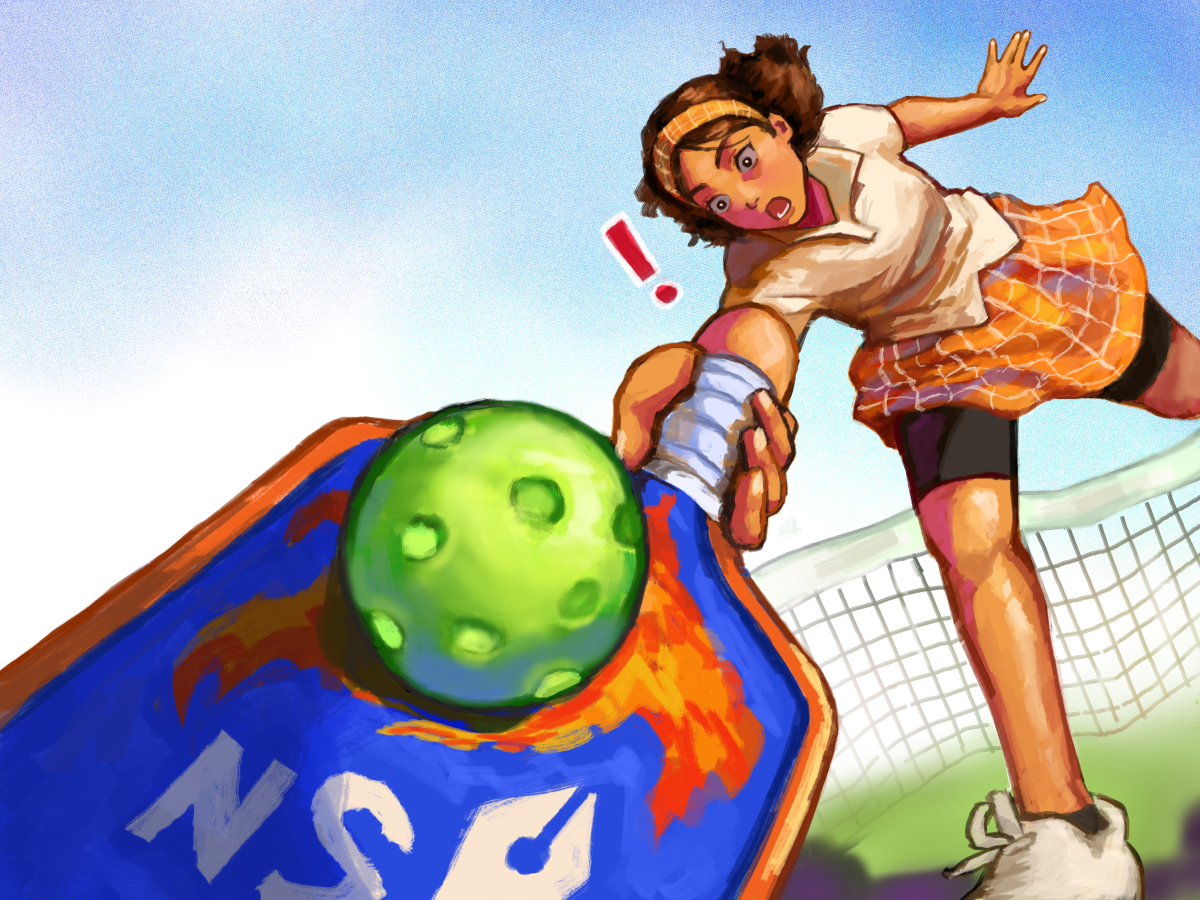
By Nash Palanca || Illustration by Aiyanna Alaon
Pickleball has been having quite the moment.
What was once an oddly named sport you might have only heard about in passing now seems to be everywhere, from newly opened courts to weekend games with friends. And while pickleball requires little more than a paddle, a plastic ball with a suspicious number of holes, and the whacking skills of an amateur, simply knowing how to swing the paddle won’t get you through every conversation. Once you start playing, you’ll quickly discover that pickleball comes with a language of its own.
To ensure you’re never in a pickle—pun fully intended—when someone asks you to prove your pickleball expertise, here are some essential terms and lingo that you need to pick .
Larping Pickleball 101
- The Mysterious Third Number
When you’re playing doubles and ask for the score, the scorer might reply with “1–0–2,” leaving you wondering: one point to my team, zero to the other, and… two to whom exactly? Now, don’t start looking around for a third team, because that third number isn’t another team’s score—it indicates which server is serving, while the first two refer to the serving and receiving teams’ scores.
So when someone calls out three numbers, there’s no need to look around for another opponent. Just remember this format: the serving team’s score, the receiving team’s score, and the server number.
- Whacking the Paddle
Pickleball is not just about swinging a paddle and hoping that the ball magically lands on the opponent’s side of the net. There are actually several terms associated with the ways players make contact with the ball.
Have you ever hit the ball before it bounced? That’s called a volley. If the ball bounces before you hit it, congratulations—you’ve just performed a groundstroke. From there, things get a little bit more interesting. Ever hit the ball so hard that it got sent to the opponent’s backcourt? Well, that’s a drive. Prefer to gently tap the ball and make it land in the opponent’s kitchen? That’s a dink. Feeling a little ambitious? Launch the ball over your opponent’s head for a lob, or unleash a powerful overhead strike with a smash.
While actually performing these shots may seem a little intimidating, casually throwing around these terms might be enough to overwhelm your opponents. Who knows? With your newfound vocabulary, they might just hand you your first-ever pickleball win for free.
- Hell’s Kitchen
Of all the things pickleball could have named its non-volley zone, it chose the kitchen. A curious choice, considering it has nothing to do with cooking. The kitchen, officially called the non-volley zone, is a seven-foot area extending from the net on each side of the court and marked by a line. Players can step into this zone to hit a ball after it bounces, but they cannot volley the ball while standing inside it. In other words, you may enter the kitchen; you simply have to let the ball bounce before you serve your next shot.
Better remember that! Trust me, nothing is more frustrating than landing a perfect hit, only to realize you’re standing inside the kitchen.
- Before You Volley
Ever served the ball, watched your opponent return it, and then volleyed it back, only to get called out? You may have just broken the two-bounce rule. Before either team can volley, the ball has to bounce once on each side—first after the serve, then after the return. Break that rule, and the rally is over.
Lose the rally while your team is serving, and you get a side-out. No, not “outside”—side-out. I know, very creative. Pickleball really does have a way with names. Anyway, a side-out occurs when the serving team loses the rally, causing the serve to pass to the opposing team. And you’ll want to hold on to that serve, because under traditional side-out scoring, a team can only score while serving. Lose it, and the other team gets their turn.
- The Nasty Nelson
As amusing as it sounds, you do not want to get called for a Nasty Nelson. Despite what the name suggests, the term “Nasty Nelson” has nothing to do with your friend named Nelson being, well, nasty. Instead, it refers to a play in which the server deliberately directs the serve at the non-receiving player, resulting in a fault for the receiving team. It is a wonderfully peculiar name for a wonderfully peculiar situation.
So, unless Nelson is standing on the other end of the court, leave the poor guy out of it.
Now You Know Ball
While all these terms may seem like tempting tools to show off your newfound pickleball vocabulary, the ultimate way to larp pickleball is by stepping on the court and having fun. You might stumble into the kitchen. You might send a lob somewhere it absolutely should not go. You might even become the unfortunate recipient of a Nasty Nelson. But who knows? You might just discover a genuine love for the game and, before long, become a certified pickleballer instead of just pretending to be one.

